
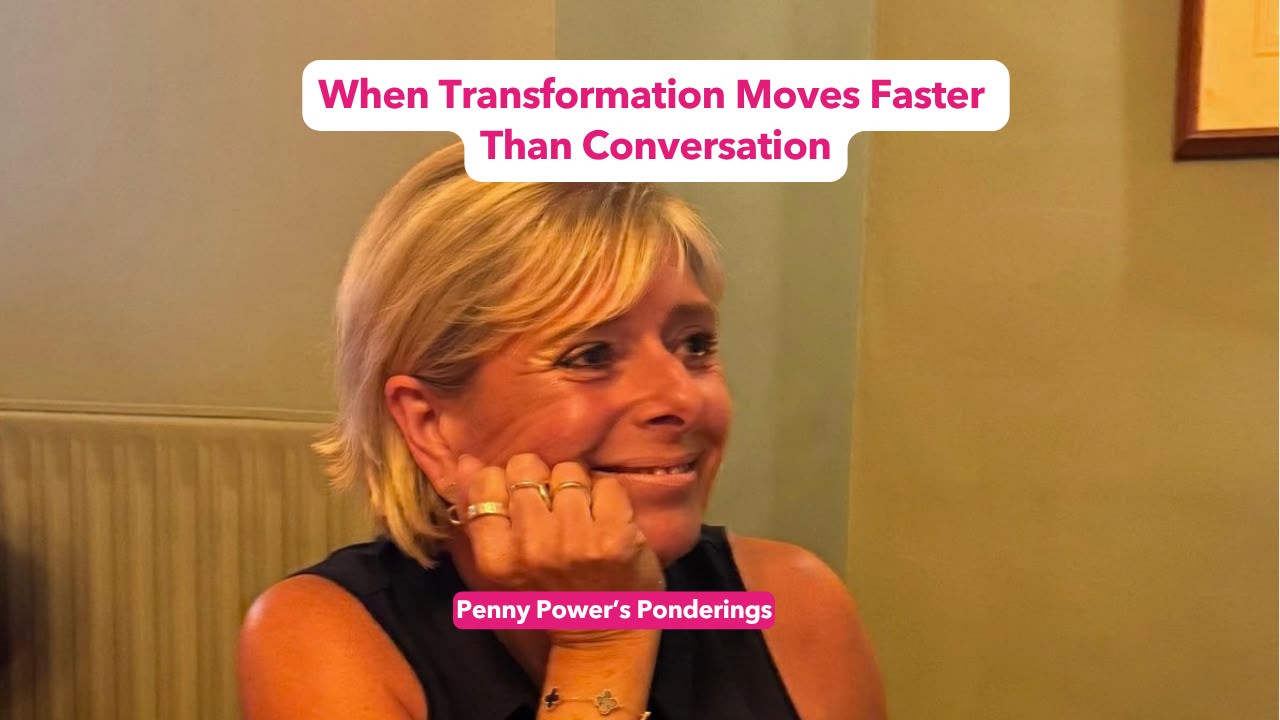
By Penny Power – Business Author & Human-Centred Speaker
I wake on Mondays with a fast-beating heart. Not just because of Thomas (!) but because my adrenaline is so high. I know the week ahead will be a balance of keeping up with technology and tasks, and desperately trying to add value to the significant relationships in my life.
This week my Ponderings are about how we all stay calm, feel in control of our lives, make the right choices, and feel safe about the direction our lives are taking. I’m also pondering how we make sure the people who matter so much to our sanity, and to our sense of mattering, don’t get pushed to the bottom of the list while we try to keep up with everything else.
Last week, I shared that I am adjusting to a new life. I am seeking a social life that ensures I am not lonely, with someone local I could go for a walk with or meet for a coffee. I have an empty nest to fill. This period is a lot tougher than when my kids went to university, because then they flew the nest but stayed within driving distance.
Now they have literally migrated to three different continents, which is a dramatic nest evacuation! I have been pondering this a lot recently, particularly as AI moves from something we experiment with to something that is fundamentally changing how we work, and how much we get addicted to another form of technology, consciously or not.
I realised that I needed to be proactive. This sounds so obvious; however, I discovered, through reaching out to seven different friends, that each one believed I was too busy to meet up.
So this week I have a lovely walk today, two lunches, two coffees and five friends that I wouldn’t have seen if I hadn’t reached out. I had to show my vulnerability, in the hope that it wouldn’t create a pity party!
I wonder whether one of the greatest risks of this extraordinary technological transformation has very little to do with the technology itself. I could definitely hide inside my technology. I am not lacking tasks or excitement about my work.
But I need people. I need to matter, and I need them to know they matter to me too. I had to be proactive, or slowly and deeply my loneliness, and my feeling that no one in my local life cares about me, would start to feel normal, and I would only have my work.
What worries me is the speed at which we are changing things without bringing people with us, and how we maintain the deep connections that I really care about. We cannot fight global and technological change.
We have to embrace it, because resisting it would set us back in business and economically. But unless we find balance, change is being done to us rather than with us, and the risk is that isolation begins to make us feel insignificant.
I know my kids know how happy I am for them and how much I encourage the decisions they have made. However, through this transformation, all five of us had to participate in the decisions being made. When we feel powerless, transformation is in danger of making anyone around it feel insignificant, unless communication and inclusion are placed right out front.
In business, I imagine the same is happening. Millions of people are using AI, stepping up, evolving, creating new ideas, and adapting. But individually, inside those companies, does our voice matter? Perhaps our experience wasn’t needed, our fears weren’t heard, our contribution wasn’t sought.
And once people begin to feel insignificant, trust in the people we once believed in can start to disappear. As we go through rapid transformation, we must include participation.
We talk endlessly about transformation. Digital transformation, AI transformation, cultural transformation, organisational transformation. But perhaps we need to remember something incredibly simple. People don’t only need to know what is changing; they need opportunities to talk about how the change affects them. That requires something technology cannot automate for us, and that is conversation.
It does not need another employee survey, another email from the leadership team, or another carefully crafted presentation explaining why the change is good for us. It needs a real conversation. The kind where someone can say “I’m worried about this” without being labelled resistant, a victim, or a burden. A conversation where people know their voice matters, even when the final decision cannot be theirs.
Interestingly, the CIPD’s recent research talks about the importance of taking strategic pauses during AI adoption. I love that. Because sometimes, when you are the one leading the change, it is not about moving faster. It is about building in a conscious pause to understand what is human before automating what is possible.
This doesn’t mean slowing innovation to a halt. It means recognising that the fastest route to adopting technology may sometimes be to slow down long enough to bring human beings with us.
AI will undoubtedly become capable of extraordinary things: writing, analysing, predicting, automating, even recommending.
We talk a lot about keeping the “human in the loop”. Perhaps the more interesting question, for any of us leading change in our families and in our work, is what is left for the significant people when we automate? How do we still notice them, listen to them, and reassure them?
How do we create open, vulnerable conversations, have the difficult ones, and build psychological safety? Basically, whatever change is happening, how do we make the human beings around us feel that they matter? What excites me is that as technology becomes more capable, these human capabilities won’t become less valuable. They will become more valuable.
So my pondering for you this week is this. Where in your life or business are decisions being made about people without meaningful conversation with them? And perhaps an even more personal question: who needs to feel that their voice matters to you right now?
Because when transformation moves faster than conversation, a trust gap can open. And when people stop believing their voice matters, a Significance Gap can open too.
With love,
Penny x
p.s. If you’d like to receive my Ponderings by email each week, please subscribe here. You can unsubscribe at any time.