By Penny Power – Business Author & Human-Centred Speaker
Many of us were active online 20 years ago; that was 2006. Thomas and I owned a thriving global social network. We started in 1998, opened the doors online in 1999 – Ecademy served Business Owners who were friends online and met in person. At its peak, 5,000 in-person events happened, and because they knew each other online, they hugged when they met. Business was done, but no one treated their relationships transactionally.
Around 2012, while social media existed well before then, we gave up Ecademy, a really tough time for us personally. There was no way we could compete with the change in behaviours; social media (broadcast) was winning over social networking (conversations and friendship). Our saddest business journey. But what is sadder is the loneliness and emotional disconnection that was being born.
Three things came together:
- The phone became the platform. The iPhone arrived in 2007 and the App Store in 2008. By 2012–13, about half of UK and US adults owned a smartphone. Social media moved from a desk you sat at to a pocket you carried everywhere, and it became the first thing people checked in the morning and the last thing at night.
- Scale crossed a threshold. Facebook passed a billion monthly users in October 2012, the same year it bought Instagram. When nearly everyone you know is in one place, being absent starts to cost you socially. This is when emotional disconnection started, loneliness became a societal issue, and sadly, we didn’t know then what impact it would have on young people.
- Messaging and broadcasting merged. WhatsApp, Twitter and Facebook Messenger blurred the line between talking to someone and performing in front of everyone. Birthdays, condolences, news and arguments all moved onto the feed.
Around 2009–2012, the platforms switched from showing posts in time order to ranking them for engagement. That’s when social media started shaping what we said as well as where we said it. It became a game, not a place to be socially supported, but to socially connect.
Ecademy ended in 2012. After it, the big platforms optimised for attention rather than relationships. “Significant relationships” were reduced; the move from connection to broadcast was fully entrenched in the psyche of most.
Clearly, there has been a growth in a subtle belief that perhaps we don’t need one another quite so much anymore. Dangerous in our home lives and a huge challenge for solopreneurs and small businesses. We all seek to know people, to be able to trust them, to know we matter; hours on tech, sitting alone in our homes- this doesn’t serve our hearts or our self-worth.
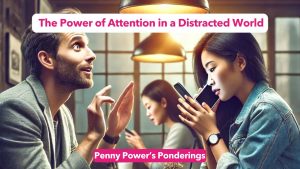
We can sit at home and scroll, watch a myriad of films without going to the cinema with a friend, double-screen even when on a sofa watching a film with a loved one, order food to our door, self-serve in shops rather than at a till, never really connecting with the experience that was supposed to be shared. If we do venture out, we are connected to our phones, searching and seeking something, when that something is probably to talk to someone!
It is so obvious to me, and others who love people, that even getting a ‘hello’, a smile, in our own towns is hard. People order their coffees without seeing the barista in front of them, even though they order from that person every day. I see it.
Now, if we knew all this would happen 20 years ago when the shift began, if we had balanced communicating through technology and in person, perhaps we would have had different outcomes.
…..and now, here we are, on the precipice of AI, and this is the opportunity for humanity to come together again, and this is why…
I don’t believe the danger is technology. The danger is the way we implement and use it. The danger is believing that we can do life alone, slowly reducing the amount of time we talk to other humans. When independence quietly becomes emotional self-containment, something precious begins to disappear.
Without the confidence that comes from human interactions that make us feel worthy of others, we stop asking for help, and we stop showing vulnerability. We stop allowing other people to contribute to our lives.
Without realising it, we begin to mistake isolation for strength. Yet, deep down, we know we still want others to care for us and see us.
The joy of togetherness.
I have spent most of my working life talking about togetherness. About community. About the extraordinary things that happen when people choose to build one another rather than simply build themselves.
One of the greatest privileges Thomas and I have had in building business communities since 1998 has been watching this transformation happen in reverse. New members often arrive carrying everything themselves. Their business. Their worries. Their decisions. Their fears. Many have become so accustomed to being everything to everyone that asking for help, learning together, feels uncomfortable, even unsafe.
Then something beautiful begins to happen. Trust grows, and we see members start to share their challenges instead of hiding them. Advice flows naturally, they feel love, and self-worth increases. Introductions for friendships or work are made without expectation. Partnerships are created. Members discover that contribution is never one-way, because allowing someone to help you is one of the greatest gifts you can give them, and significance is reciprocal.
We feel significant not only when we contribute to others, but when someone trusts us enough to let us contribute to them. The giving and the receiving of a deep human experience.
I wonder if you can see yourself in any of my thoughts?
The strongest people I know are not the ones who survive alone. They are the ones courageous enough to need others. We all need human interactions, and even the smallest of significant interactions can transform our lives.
If your business is being AI’d and Automated, that is fantastic, but can you have an additional strategy running alongside this? Ask yourself and your business.
With all this automation, efficiency, and time saving, how do we use this opportunity of increased time and capacity to show the people that matter to us, that enable us to have a good life, that they truly matter to us?
The uniqueness of each of us is what makes this world a joy, to be seen, to after makes this world work.
How do we increase human connection, since we have now created more time?
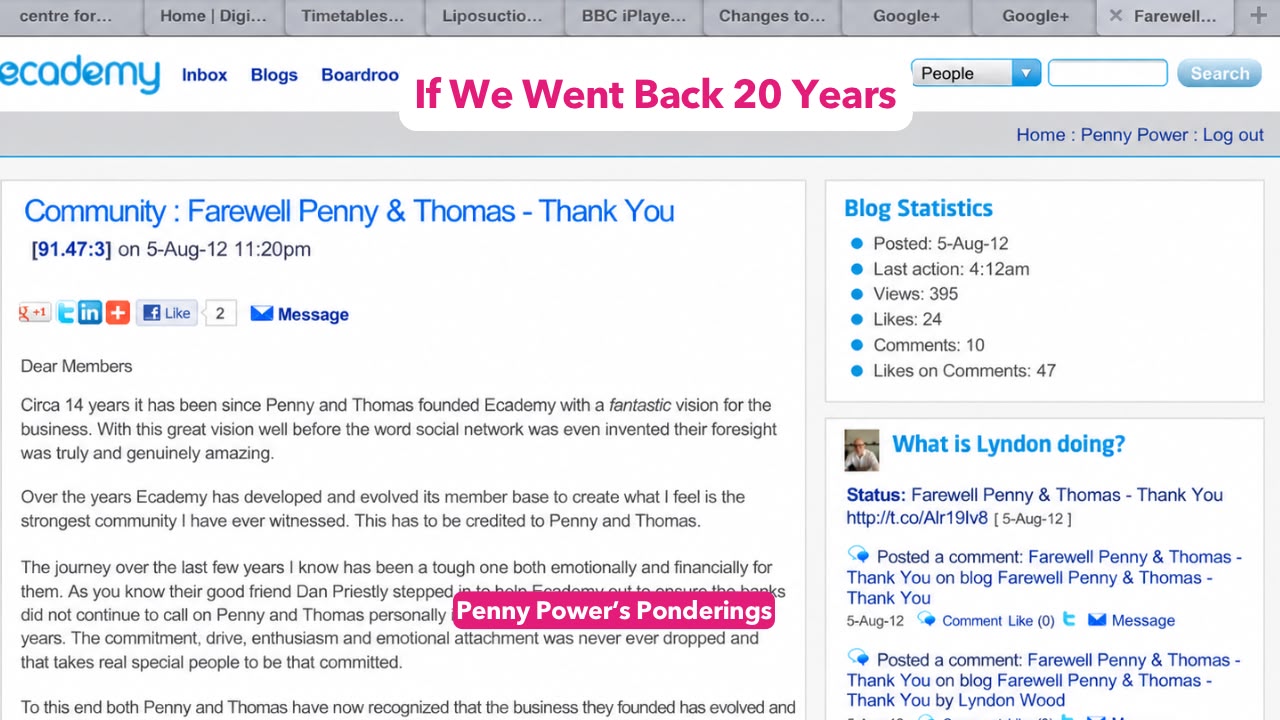
P.S.: The image I have shared is of the final goodbye to us when we had to give up our dream, and Ecademy left our lives. 5th August 2012. A day we will never forget; if any of you reading this knows this feeling, I send my love. What I will share is that we never gave up on our beliefs, and we may do it in a smaller way now, but it is just as rewarding; people need people even more now than they knew they did back in 2012.
With love,
Penny x
p.s. If you’d like to receive my Ponderings by email each week, please subscribe here. You can unsubscribe at any time.