By Penny Power – Business Author & Human-Centred Speaker
Many of you know that I have spent most of my working life talking about togetherness. About community. About the extraordinary things that happen when people choose to build one another rather than simply build themselves.
This week I’ve been pondering something that seems to be quietly growing all around us.
Individualism and the joy of togetherness.
At first glance, togetherness feels wonderfully empowering. The freedom to make our own choices, create our own path and prove to ourselves that we can succeed through our own determination. There is something deeply satisfying about building a life through our own effort, our own talent and our own resilience.
For many people, individualism also feels safe.
“If I rely on no one, no one can let me down.”
“If I do it all myself, no one can take the credit.”
“My success belongs entirely to me.”
I understand these thoughts because, for a period of my own life, I lived them.
After losing trust in people through difficult business experiences, I became incredibly self-reliant. Someone once described me as “uncoachable”. I convinced myself that controlling everything meant protecting everything.
Looking back, I can now see that what I thought was strength was actually self-protection.
The more independent I became, the lonelier I felt.
I became hyper-focused on my own success and survival, but somewhere along the way I lost the joy of contribution, the comfort of being truly known for who I was, and the freedom that comes from allowing other people to carry just a little of the load with you.
I wasn’t strong.I was simply protecting myself.
Over the past twenty years, I wonder whether many of us have quietly been encouraged to do the same.
The iPhone in 2007 gave us independence. Social media over the past 20 years has given us our own platforms. Remote working gives us physical separation. Artificial Intelligence is now giving us unprecedented autonomy, building a company around us without people doing the tasks.
Each of these advances has brought extraordinary benefits, and I embrace them all.
But together they have also created something else.
A subtle belief that perhaps we don’t need one another quite so much anymore.
I don’t believe the danger is technology.
The danger is believing that we can do life alone.
Healthy independence is a wonderful quality. It builds confidence, resilience and responsibility. But when independence quietly becomes emotional self-containment, something precious begins to disappear.
We stop asking for help and we stop showing vulnerability.
We stop allowing other people to contribute to our lives.
Without realising it, we begin to mistake isolation for strength. Yet, we know we still want others to care for us and see us.
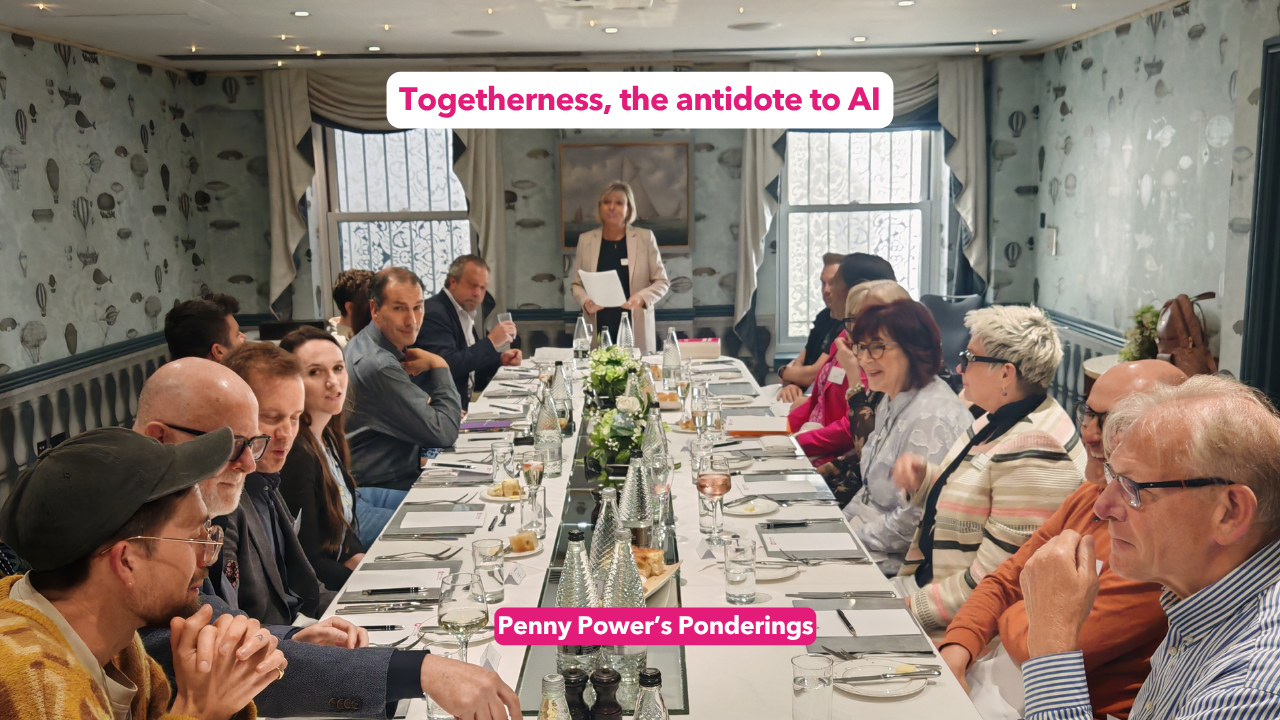
One of the greatest privileges Thomas and I have had in building BIP100 has been watching this transformation happen in reverse.
New members often arrive carrying everything themselves. Their business. Their worries. Their decisions. Their fears. Many have become so accustomed to being everything to everyone that asking for help, learning together, feels uncomfortable, even unsafe.
Then something beautiful begins to happen.
Trust grows, and we see members start to share their challenges instead of hiding them.
Advice flows naturally and they feel love and self worth increases..
Introductions are made without expectation. Partnerships are created.
Members discover that contribution is never one-way.
Allowing someone to help you is one of the greatest gifts you can give them, because significance is reciprocal. We feel significant not only when we contribute to others, but when someone trusts us enough to let us contribute to them. The giving and the receiving of a deep human experience.
Perhaps that is the great lesson of our time.
And, with AI being used well, it is not about burning your brain even more through hard work, its by using the time saved to be human again, to have time for one another.
So this week, I invite you to ponder something.
Where has healthy independence quietly become emotional isolation?
Who in your world might be waiting for you to trust them?
And what might change if, instead of proving you can do life alone, you allowed someone to walk alongside you?
After nearly forty years in business, I have come to believe something very deeply.
The strongest people I know are not the ones who need nobody.
They are the ones courageous enough to need one another.
With love,
Penny x
p.s. If you’d like to receive my Ponderings by email each week, please subscribe here. You can unsubscribe at any time.